A Reader's Route Through a Long News Feature
A reader's route through a long news feature helps you read with purpose, use its structure and keep useful questions without losing the story's thread.
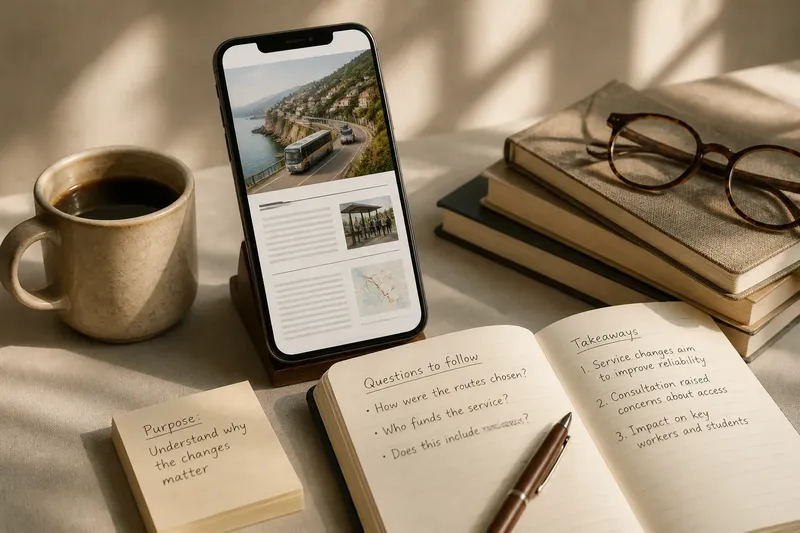
You have a train ride to fill, a long news feature open on your phone and no wish to remember every paragraph. A reader's route through a long news feature starts by deciding what you need from this particular read. That small choice makes the story easier to follow without turning it into homework.
Choose a purpose before you begin
A long feature may trace a public decision, explain a social change or follow people living with its consequences. You do not have to approach every story in the same way. Ask yourself what would make this reading useful now: understanding the central issue, following one person’s experience, or identifying what remains unresolved.
Keep the purpose broad enough to leave room for surprise. “I want to understand why the dispute matters” gives the feature space to complicate your view. “I want this story to prove my side is right” narrows the route before the reporting has had a chance to speak.
If the feature is tied to something you will do later, give that task a place in your mind. A reader preparing for a local meeting might want the main arguments and the decisions still pending. Someone reading out of curiosity might care more about how events unfolded. Neither purpose is more correct; each directs attention differently.
Use the structure as a set of signposts
Before settling into the opening, glance at the headline, standfirst, section headings and any captions. These elements give you a rough map, not a substitute for the article. Notice how the headings divide the subject: perhaps one section establishes a scene, another explains a policy, and a later one examines its effects.
Then read the opening at an unhurried pace. News features often begin with a person, place or moment before widening into context. Treat that opening as a doorway. The central subject may become clearer only as the article moves between scene, explanation and evidence.
Section breaks can help you recover your place after an interruption. At each one, pause for a breath and ask what changed: Has the story moved to another person? Has the reporting shifted from what happened to why? A simple answer keeps the article’s shape in view without demanding a formal set of notes.
Captions and graphics can add information that the main text does not repeat. Read them as part of the feature, especially when a chart, map or photograph identifies a place, relationship or change. But do not assume a striking image carries the whole argument; the surrounding reporting explains what it can and cannot tell you.
Keep questions without breaking the thread
One good reading habit is to let a question wait. If a name, term or claim catches you, make a brief note and continue until the article gives more context. Features often answer questions gradually, and an early detail may gain a different meaning later.
Use a notes app, the margin of a printout or a scrap of paper. Keep each note short: “Who funds this programme?” or “Does the account include rural areas?” A question is more useful than a copied paragraph because it tells you what to look for when you return.
Say you are reading a feature about a town’s changing bus routes because you will attend a neighbourhood discussion. You note that the article describes a service change but does not yet explain how the route was chosen. As you continue, you spot a section on the consultation process; that may answer your question. If it does not, you can bring the unanswered point to the discussion rather than interrupting the whole read to search elsewhere.
Not every unfamiliar detail deserves a detour. It is usually not worth pausing to look up a minor name or every passing reference if neither affects the feature’s main point. Save that effort for terms, claims or missing context that could change your understanding.
What should you do when a section feels dense?
Should you skip ahead?
Try the section heading and the first sentence of the next section before skipping. If the dense passage supplies context for what follows, read it once more at a slower pace; if it is a side detail unrelated to your purpose, move on and mark the point to revisit.
What if the feature introduces unfamiliar terms?
Look for a plain-language explanation nearby, often in the same paragraph or a caption. If the term remains unclear and matters to the story, note it for a later check rather than guessing at its meaning.
How can you tell whether a question has been answered?
Check whether the article gives a direct response, offers evidence that bears on it, or leaves it open. Those are different outcomes: an unanswered question is not automatically a gap, but it should not be mistaken for a settled point.
When is it useful to return to a feature?
Return when a later section changes how you read an earlier scene, or when you need a detail for a conversation or decision. Use your notes to find the passage instead of starting over without a reason.
Close the read by sorting what you know
At the end, take a moment to separate the article’s main account from the questions you carried. You might jot down three things: the feature’s central claim, the evidence or scenes that shaped it, and one point it leaves unresolved. This is not a verdict on the reporting; it is a compact record of your own understanding.
Be careful not to turn an engaging person’s story into proof of a broad pattern by itself. A feature may place an individual experience beside documents, expert explanation or other accounts. Notice what each part contributes, and keep the limits of the story in view.
If you plan to share the feature, pass along the point that mattered to you and the context that made it intelligible. A link without explanation asks someone else to reconstruct your route. A sentence about the question the article helped you answer—and the one it did not—offers a more useful invitation.
A reader's route through a long news feature is not a race to the final line. It is a way to give the story your attention while keeping your own purpose visible. Let the structure guide you, let worthwhile questions travel with you, and leave room for the article to change what you thought you were looking for.