Before the Newsroom Desk: How Copy Reached the Page
How copy reached the page before the newsroom desk: trace the marked sheets, hand composition and proofs that turned reports into printable type.
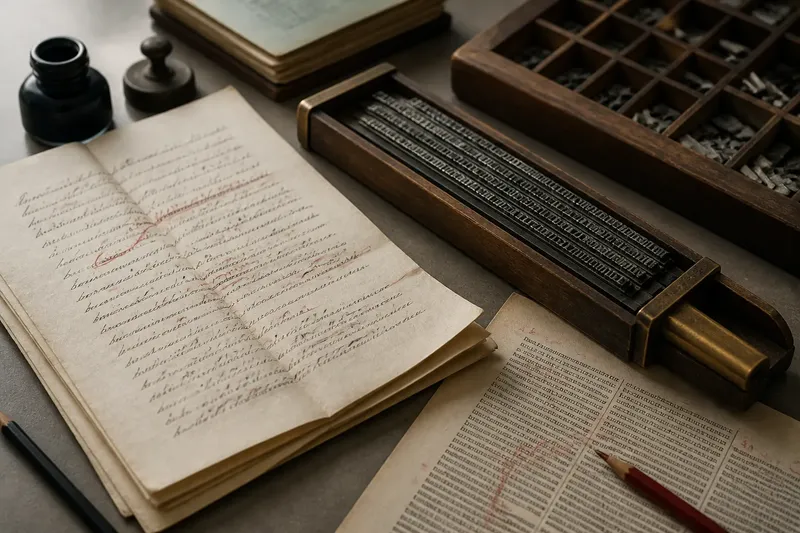
A folded manuscript sits beside a printer’s composing stick, its cramped corrections competing for space with the original words. How copy reached the page depended on the printing process, the office’s routines and the people handling each handoff. There was no single route shared by every paper or period.
Copy travelled in different forms
In nineteenth-century newspaper production, a report might reach a printing office as handwriting, a typescript, or a message relayed by telegraph and written down at its destination. The form depended on the correspondent, the communications available and the paper’s working arrangements. A telegraphed report, for example, usually arrived as a written message rather than as a physical sheet of the reporter’s original copy.
Editors and printers had to distinguish the story from its marks: insertions, deletions, punctuation and directions about placement. A note could be separated from the passage it governed, while an unclear name could be misread. Copy was therefore not just a container for words; it was a working document whose condition shaped what the next person could understand.
Printing offices differed in size and organisation. In a small shop, one person might handle several parts of production; a larger newspaper office could divide editorial, composing and proofing work among different staff. Any account of the process should allow for that variation rather than assume every shop followed the same chain of hands.
Hand composition turned copy into type
Before keyboard-operated linecasting became established in newspaper production, compositors commonly assembled pages from individual metal sorts. Reading from manuscript or marked copy, a compositor placed pieces of type into a composing stick, arranged in reverse so the printed impression would read correctly. Lines were then assembled into a larger page or column arrangement.
This was skilled, close work. The compositor had to keep the copy in view, interpret its marks and fit words into the available measure. Once type had been arranged, it had to be secured in the page form so it would stay in position for printing. A late change might mean resetting type or adjusting the surrounding arrangement.
The process brought the compositor into direct contact with the text, but it did not make that worker the final authority on meaning. Editorial decisions about wording, emphasis and placement belonged to the newspaper’s own working structure, which varied across publications. When copy was ambiguous, the safest response was clarification, not confident guesswork.
Proofs carried corrections back to the type
After type had been composed, a printer could take a proof: an impression used to inspect the setting before the page went to press. A proofreader or editor compared it with the copy available to them, looking for errors such as omitted words, wrong letters or punctuation that had changed in composition.
Corrections then had to be communicated clearly to whoever altered the type. A change could affect spacing or force a line to be reset, so the compositor needed to know both what to change and where. The proof was not a guarantee that every error would be caught; it was a stage that made checking and correction possible.
Say a local correspondent sends a handwritten report with a street name that could be read in two ways. The editor marks the uncertain name and seeks confirmation before it is set; the compositor leaves the wording unresolved rather than choosing a reading. When the confirmed spelling appears on the proof, the editor checks it against the reply before the page is prepared for printing. The result is a more legible report, with less risk of turning an uncertain scrawl into a printed error.
Machines changed how type was assembled
In the late nineteenth century, keyboard-operated composing machines changed the scale and rhythm of typesetting in many newspaper offices. Linotype operators used a keyboard to assemble matrices and cast a complete line, or slug, in metal. Monotype used a keyboard to produce a perforated paper tape that controlled a separate caster, which produced individual sorts. These systems worked differently, and their use varied by publication and place.
Mechanisation changed the unit of work, but it did not settle questions of meaning. Operators still had to read copy, distinguish corrections from text and handle material that did not fit the measure. A late revision could require recasting or resetting, depending on the system and the change. The printed page concealed much of this labour, but it still depended on it.
Nor did mechanical composition make hand setting vanish everywhere at once. Different methods could coexist, and the choice of equipment depended on a shop’s circumstances. A history of newspaper production is clearer when it describes the change as an uneven adoption of tools, not a universal overnight switch.
What did each handoff make easier or harder?
Why could handwritten copy slow composition?
Handwriting and corrections varied, and a crowded page could make the intended order unclear. If a name or instruction could not be read confidently, the next worker needed clarification rather than an invented interpretation.
What did proofreaders compare?
They checked the proof against the copy or corrected version designated for that job, looking for omissions, wrong characters, punctuation slips and unmade corrections. The chosen source mattered: comparing against an outdated draft could introduce fresh confusion.
Did composing machines remove editorial judgement?
No. Machines altered the mechanics of setting type, while people still had to resolve unclear copy, approve wording and decide which corrections to make. Faster composition could not determine what a correspondent meant.
What is not worth romanticising about hand composition?
The craft involved patience and skill, but also repetitive handling, close visual work and the possibility of errors reaching print. A letter set by hand was not inherently more accurate than one produced by a machine.
Duplicated copy multiplied versions
Typewriters and carbon paper made it possible to produce several copies of a typescript without rewriting every page. That could help an office circulate material, but it also created a version-control problem: the original, a corrected copy and a proof might carry different changes.
The number and roles of people handling copy varied, as did the paperwork used to track revisions. The practical question remained consistent: which version should guide the next stage? Keeping pages together, marking amendments clearly and identifying the current text were ordinary production tasks, not minor clerical details.
What was not worth the effort was treating a new tool as a cure for unclear writing or muddled instructions. Carbon copies could spread text; they could not decide which amendment was authoritative. That still required a person to make the decision visible to the next worker.
The object passed between workers tells the story
A marked manuscript, a line of type, a proof and a duplicated typescript each gave the next worker different things to see and change. Following those objects reveals where editorial decisions entered production, where errors could arise and how corrections travelled back through the shop.
How copy reached the page is best understood as a set of changing practices, not one fixed pipeline. Printing technology altered the work and its handoffs, while local routines shaped who did what. A useful detail to notice is the source used for a correction: knowing which copy was authoritative helps explain why a mark on one sheet could matter more than a mark on another.