From Assignment to Published Story: The Editorial Handoff
The editorial handoff turns an assignment into a publishable story by clarifying ownership, carrying essential context and catching gaps at each stage.
A reporter opens a fresh document, sees a bare assignment note and wonders what the editor expects by the end of the day. The editorial handoff is the route from that note to a published story, and each pass should answer a different question: what are we making, what can we support, what needs shaping and what is ready to go?
A handoff is not merely a file moving from one inbox to another. It is a transfer of purpose and responsibility. If the next person has to guess what has been checked, what remains uncertain or what decision is needed, the story can stall even when the writing is strong. Treat each stage as a small editorial agreement, recorded in plain language.
Turn the assignment into a shared brief
The assignment editor’s job is to define the story’s reason for being. A useful brief gives the reporter a reader-facing question, the intended scope, the people or documents needed to answer it, and a deadline for the next check-in. It should also say what the story is not trying to establish. Boundaries prevent a promising lead from swelling into several different articles.
Before reporting begins, read the brief back to the editor in your own words. Ask which claim must be supported, whose perspective is essential and what would make the story too thin to publish. Clarify the expected deliverable: a short update, a full report, a scene-led feature or another form. If the assignment depends on an event or developing situation, agree how changes will be handled.
Record the answers where the reporting will happen: in the assignment system, a shared note or the top of your working document. Include names and roles as they are understood, relevant links, contact details, the next deadline and any unresolved editorial question. Keep the note usable. A long transcript of the commissioning conversation is less helpful than a concise record of decisions.
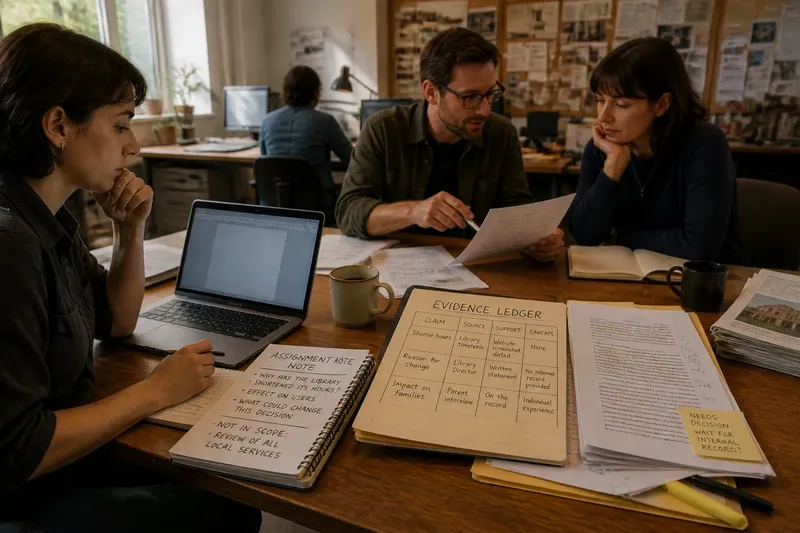
Say you receive an assignment to explain why a neighbourhood library has shortened its opening hours. The editor and reporter agree that the story will examine the stated reason, the effect on users and what the library says could change the decision; it will not attempt to review every local service. That shared boundary gives the reporting a direction without deciding the conclusion in advance.
Report against the question, not the first theory
With the brief agreed, the reporter owns the reporting. That means gathering material that can answer the assignment, keeping a record of where it came from and alerting the editor when the premise shifts. Start with a source map: the people with direct knowledge, the relevant records, the organisation responsible and anyone likely to be affected. Note what each source can establish and what they cannot.
Maintain a simple evidence ledger alongside your notes. For each important claim, record its source, the supporting material and any caveat. Separate what you directly observed from what a source told you, and distinguish a confirmed fact from an allegation, estimate or interpretation. This is not paperwork for its own sake. It lets an editor see where a sentence comes from without reopening every conversation.
Keep the editor updated at agreed points, especially when a central source declines to comment, a document contradicts the working theory or the reporting uncovers a new risk. Bring the problem with a proposed next move: another source to contact, a narrower claim, a revised deadline or a changed angle. Editors can help make those decisions, but they cannot responsibly make them from silence.
What is not worth the effort? Sending every small note or draft sentence as it happens. A steady update at the agreed moment, plus an immediate message when the story’s direction or publication risk changes, is easier to act on than a running stream of fragments.
Draft so another person can verify the story
Once enough reporting is in hand, the reporter turns the evidence into a readable draft. Lead with the central development or answer, then organise the supporting material so the reader can follow how the story is known. Put the strongest, most consequential claims near their evidence. Attribute opinions and disputed accounts clearly rather than using a confident tone to disguise uncertainty.
Drafting is also the moment to expose gaps, not paint over them. Mark a point that still needs confirmation in the newsroom’s agreed way, and tell the editor what is missing. Do not leave a placeholder that might be mistaken for finished copy. A useful handoff note accompanies the draft and states what is ready, what remains open, which sources have been approached and where the supporting material can be found.
Imagine the library’s director provides a written explanation, while a parent describes finding the shorter hours difficult and a public timetable confirms the change. The reporter’s note can distinguish those three kinds of support, flag that the library has not supplied its internal decision record and ask whether the article should wait for it or proceed with that limitation made clear. The editor now has a decision to make, rather than a puzzle to solve.
Give the editor a draft with a clear route through it
The assigning or line editor checks whether the draft answers the agreed question. Their pass is not simply a hunt for awkward sentences. They test the structure, identify unsupported leaps, check that the scope still fits and ask whether a reader can tell who is making each claim. They may suggest a different order or ask for more reporting; the reporter remains responsible for resolving factual questions and correcting the record.
Make the editor’s review easier by sending a clean draft and a short handoff note together. Link or label the relevant documents and notes, flag names or terminology that need checking, and list the questions that are genuinely unresolved. If a paragraph rests on a sensitive or contested claim, point directly to its support. This saves time without asking the editor to accept the reporter’s judgement on trust.
When edits come back, separate factual corrections from changes of emphasis and style. Query a change if it alters meaning or makes a claim stronger than the evidence allows. If new reporting is requested, agree who will obtain it and when the revised copy is due. Do not silently reject an edit or accept one that introduces a factual error; make the disagreement visible and resolve it before the story moves on.
Prepare the copy for a publication decision
After the draft has been shaped and outstanding reporting dealt with, a senior editor or duty editor decides whether the story is publishable now, needs another pass or should wait. That decision includes more than prose quality. The editor considers the significance of the story, the strength of its support, the right level of detail, unresolved responses and any legal, privacy or safety concern that calls for specialist advice.
The reporter should make clear what changed during editing and whether any facts remain unconfirmed. The editor checks that essential caveats survive a trim, that a response has not been separated from the allegation it answers and that the headline reflects the copy rather than a more dramatic version of it. If a material gap cannot be resolved, the choices are to disclose the limitation, narrow the claim, hold the story or decline to publish it.
For sensitive matters, follow the newsroom’s review process and seek a qualified professional where the issue requires specialist legal or safety judgement. Which records must be retained, what can be published and how a response should be handled can depend on applicable law, newsroom policy and the particular facts.
Make the production handoff explicit
Editorial approval is not the same as publication readiness. The production handoff gives the person preparing the story for release the final copy, approved headline and any necessary display material, along with clear notes about links, captions, names and timing. Identify which version is final. A document labelled “latest” is an invitation to publish the wrong file.
Before release, the responsible editor or producer checks the rendered story, not just the document. Confirm that the headline and opening match the approved text, links lead to the intended material, captions identify the right people and images, and formatting has not obscured a qualification or attribution. Check that the publication time and any coordinated release instructions are clear to the people carrying them out.
Keep changes after approval visible. If a last-minute correction affects a central claim, return it to the appropriate editor rather than treating it as a production tweak. A typo may be fixed within the agreed workflow; a new fact, a changed allegation or a revised headline can alter the editorial meaning and needs an editorial decision.
How should the handoff work when plans change?
What belongs in an editor update?
State what has changed, why it matters and what decision or help you need. Include the next deadline and the best-supported option, so the editor can respond without reconstructing the reporting.
What if a source does not reply?
Record when and how the source was contacted, then tell the editor whether the unanswered question affects the story’s central claim. The editor can decide whether to wait, proceed with clear attribution or narrow the copy.
Who owns a correction discovered before publication?
The person who spots it should flag it promptly, but the relevant editor owns the decision about what changes and whether the story needs another review. Keep the corrected source material attached or linked so the next person can verify the fix.
When is a story ready to move to production?
Move it when the responsible editor has approved the copy, material claims have support, open issues have a recorded decision and production instructions are unambiguous. If any of those conditions is missing, name the gap instead of passing the draft along as finished.
Leave a record that helps the next shift
After publication, the handoff does not vanish. Store the final copy with its source notes and decision record according to newsroom practice, and tell the editor about any immediate factual concern or significant response. If a correction is needed, make the change through the publication’s correction process and preserve a clear account of what changed.
The editorial handoff works best when every person can see both the story’s current state and the next person’s job. A concise brief, traceable support, direct questions and an explicit approval are modest habits, but they keep responsibility attached to the work as it moves. Before sending a draft onward, ask one practical question: could the next editor tell what is settled, what is open and what you need from them without asking you to start again?